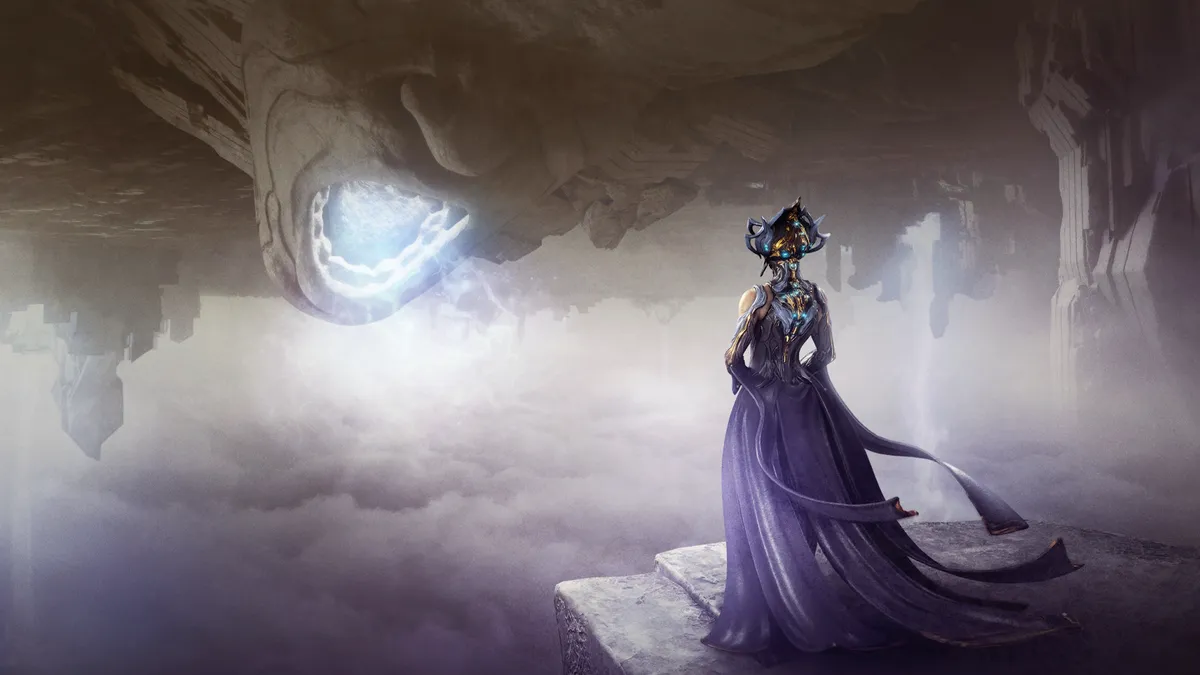
After years of meticulous planning (and a little improvisation), it’s finally happening: Warframe is opening up a second star system, Tau, on December 9. This has involved no small amount of stage setting, including the explosion/implosion/ingestion of an entire planet. But with that pivotal moment came a brief—and, to many, worrisome—message.
Warframe spoilers follow.
After players banded together to feed Eris, a dwarf planet overrun with infested monstrosities, to Praghasa, a space ship that is also the mother of Lotus, who is players’ adoptive mother, Lotus prepared everyone for what’s to come.
“Praghasa can now reach Tau,” she wrote in an in-game message to players. “I must pilot her, and become one with Praghasa. When we get to Tau, it will be with my strength. I will not be able to free myself from her in Tau. I will watch over you, but I can only be with you here on the Origin System. In Tau, I will be my true self: Natahgasa, The Sungazer—blind once again, empty of all but wisdom.”
Upon reading this earlier in November, some players speculated that Lotus was done for—at least in the sense of maintaining her own separate identity and consciousness. They found the implications heartbreaking: In many ways, Lotus is Warframe’s emotional core, the character who’s been with players since day one, guiding their Tenno—psychic child soldiers who pilot Warframes—out of an amnesiac slumber and through countless missions, leading to reveals of their (and her) true identities. Players call her “space mom” for a reason. It didn’t help, in players’ minds, that Lotus has semi-recently been in and out of the picture for plot reasons. Now, they feared, they’re on the verge of losing her again, this time possibly for good.
But, as part of a recent Warframe: Tau preview event, developer Digital Extremes told Aftermath that the reports of Lotus’ death have been greatly exaggerated.
“[Lotus] is absolutely still relevant,” said creative director Rebb Ford, who is also Lotus’ voice actor. “She is an ongoing series. She’s not being tucked away. It's just a different exploration because, as a character, she had a lot of struggles with the initial Tau vision [set in motion by Ballas, a villain]. She was basically forced to become Praghasa to get people to Tau. [This happened] five years ago now [during Warframe's New War arc], and I joked that we could have done an Avengers Endgame[-like recap] in theaters again with a bonus sequence just to remind people. But we will be doing our best to emphasize what is beyond permanence and what isn't, because we like to keep our characters around for many, many uses."
Some players speculated that, after all these years of wearing hats on hats on hats like a Team Fortress 2 character, Ford was ready to step back from voice acting and, in service of that, effectively write Lotus out of the game’s future content. That is decidedly not the case.
“There won't be a day next week where I'm not in the recording booth as that feature [of Lotus fusing with Praghasa] plays out,” said Ford.
That said, Ford’s approach to Lotus is unique. When it comes to including her in the story, Ford refuses to let her own biases cloud her judgement.
“I think the truth of that character is, when we have a need for her, we always have a second set of opinions, because I don't feel comfortable giving myself work,” said Ford. “In the most recent case of this Praghasa-Natahgasa moment in Tau, [design director] Pablo [Alonso] and I spoke about it before we proceeded, so that we would make sure it wasn't out of such a conflict of interest.”
Players’ mom becoming one with their grandmother—who, again, is a spaceship—might not strike you as the most intuitive plot beat, but that’s kind of Warframe’s whole deal. It’s an at-times convoluted mishmash of ideas, stories, and genres, some recent and others 13 years old. One of the development team’s brightest north stars, in fact, is “Keep it weird.”
“The one thing [Alonso] and I reflect on most with the most vigor is ‘Keep it weird,’” said Ford. “The biggest thing we look at is like ‘Is this weird enough?’ And sometimes it's not, and we have to live with that, and then we'll just get weirder soon after.”
End of spoilers.
Tau is pretty weird. During the preview event, Ford and Warframe director of community and live ops Megan Everett guided viewers through the dripping, Giger-esque caverns of Fornax, an orbital ring city overrun with synthetic beings known as Sentients, who—at least in Fornax, specifically—are addicted to drugs and gambling. There, they encountered mafia members, including hulking brothers who’ll hunt you through missions if you’re playing the game’s more challenging Steel Path mode, and a lounge singer whose microphone is also a Sentient. That’s the fun part of Tau: Pretty much anything can be a Sentient.
"Everything is a Sentient: the microphone, the slot machines, the card table, the ring itself,” said Ford. “There's a moment that I have forbidden anyone [at Digital Extremes] to talk about or market because I want people to see it in the quest."
In this regard, the studio tried to strike a delicate balance: Embrace the Sentients’ inherent strangeness, but don’t make them impossible to parse.
"You're not going to get your standard humanoids—your headshots, your marines, your robots. We're getting weird bird mechanical organisms with some level of humanity to them, and the lore around them is complicated in terms of, OK, they are technically an AI species that's self-replicating, that is a hivemind, but there's also some that [are not]," said Ford.
"[Sentients are] amorphous, but in a way that you can see the silhouettes of the enemies,” Alonso told Aftermath. "As humans, we like anything that has close to a face. We relate to that. But Sentients are just weird enough that they're more like insects, and it's hard to really add those personalities to them in a way."
Fornax’s mob theme, then, serves to ground one of Warframe’s more abstract factions.
"I love that we picked a veneer of 'Oh, this is what happened to the abandoned Sentients that essentially had free will. They regressed to crime and drugs,’” said Ford. “I think that made every creative challenge come back down to Earth with a very actionable touchstone that made a lot of the sound design, voice acting, enemy design, and weapon design doable for Warframe."
But Ford and Alonso tried to avoid humanizing Sentients too much. They had to, in their own words, keep it weird.
“[With] our Sentient lounge singer, Larynde, we were doing TennoCon, and [Alonso]’s like ‘Something’s not right. She's too small. It's too normal. She shouldn't be human sized. Make her bigger,’” said Ford. “So then we were like ‘You know what? She’s Sentient.’ And we put a three-times scale modifier on her, and then she got big. She got weird, and that was exactly the execution of this principle we find ourselves in with Sentients.”
“It took some convincing, especially with like level artists and stuff,” said Alonso. “They're like ‘Everything's working so well; it's so balanced.’ And we were like, ‘No, make her bigger, make her bigger.’”
At launch, Tau will be composed of two planets: Fornax (itself divided into three zones) and the sandstorm-ridden, wartorn colony of Perita. As in Warframe’s Origin System, you’ll be able to do a plethora of missions across both—including a new Spy mission, a mode the game hasn’t touched in quite some time. You'll also be able to play an in-game card game called Portau, go on first-person, exploratory "night walks," and drive flying cars between locations. But two planets isn’t all that many compared to the Origin System’s sixteen. That said, Digital Extremes plans to expand Tau faster than you might expect.
"We are approaching next year with a pretty fleshed-out plan in terms of giving Tau an immediate follow up,” said Ford. “We like to set player expectations appropriately, so the one realm that players can expect to have an update of this size is our Echoes cadence. ... Tau is going to be showing you things on launch, and earlier than expected, we will be going to one of the telegraphed locations on the star chart. So players are going to see planets and regions they can't go to at launch, but we will be turning one of them on pretty soon after the follow up of Tau."
Recommended
 Nathan Grayson