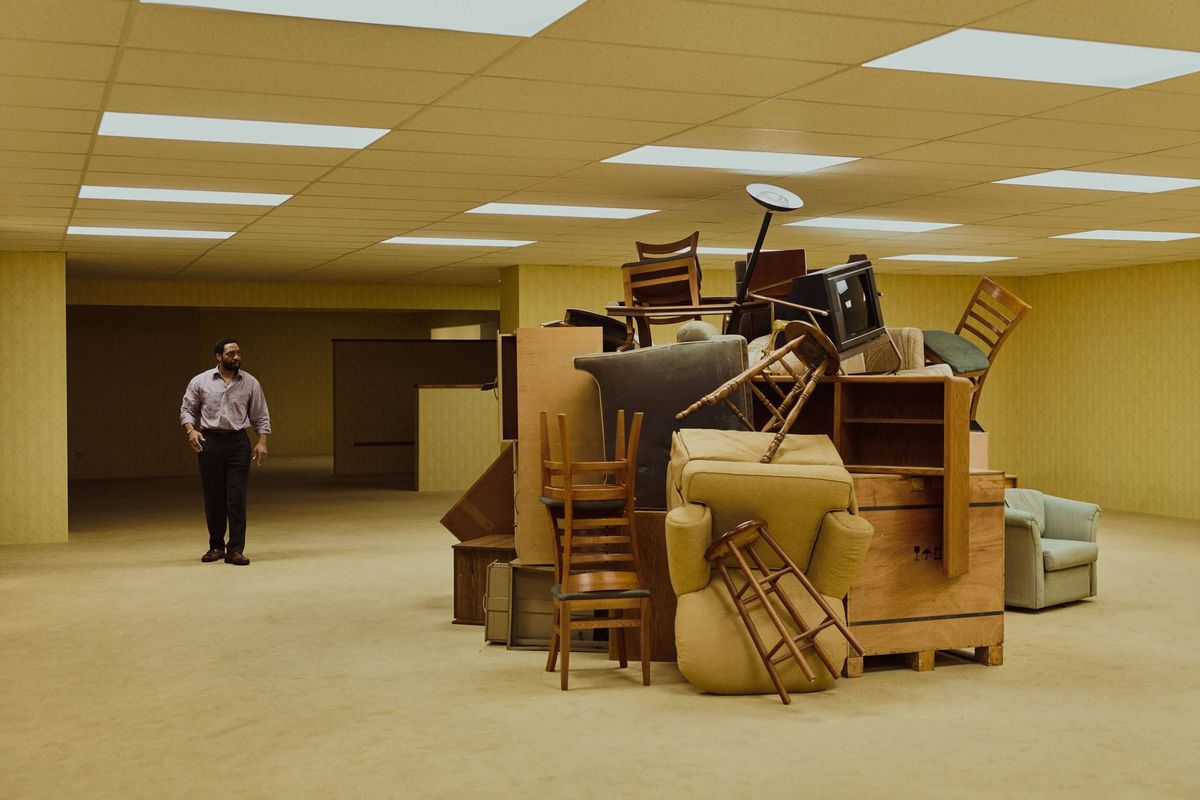
Over the weekend I, an avowed horror movie wuss, finally worked up the courage to watch Backrooms, A24’s big screen take on the popular YouTube series. I was relieved that I didn’t find it that scary, especially in the back half. Part of the terror, and the allure, of the Backrooms mythology is that viewers can map so many fears onto it, from run-of-the-mill monsters to societal issues like capitalism, the internet, and AI. While the AI metaphor is easy to see in Backrooms, it finds its most chilling expression in the brief appearances of research company Async.
Backrooms is based on Kane Parson’s mysterious, disjoined YouTube series, primarily comprised of found footage from either people who’ve accidentally fallen into the endless, twisted space, or from expeditions run by in-universe research institute Async, which sees the backrooms as the solution to the world’s storage and housing needs. Async plays only a small role in the film, which instead focuses on protagonist Clark, a furniture shop owner who finds a doorway into the backrooms in his store.
(Spoilers for the end of Backrooms.)
A main takeaway from the movie is that the backrooms are a reflection of Clark’s fears and resentments, turning what he brings into the space into eerie rooms and terrifying monsters. When Clark’s therapist Mary goes in after him, she too becomes part of the backrooms, with it iterating on her childhood home and even creating a warped copy of her that we see at the end of the movie.
Many viewers have seen how the backrooms change based on its visitors as a metaphor for generative AI, given the backrooms’ faulty facsimiles of real human things–Clark explains it in the film as describing a dog to someone who’s never seen one and then asking them to draw it. YouTuber OzymandiasV2 argues that, seen through this lens, Clark’s ultimate decision to remain in the backrooms at the end of the movie is a great metaphor for generative AI users, saying that there are now no demands for Clark to “change, grow, or express anything resembling an original thought… He can exist without the exhausting labor of producing meaning. This is a similar promise that many find in generative AI.”
This metaphor goes one step further when Async enters the picture. At the end of the movie, Mary ends up in Async’s facility, where a researcher named Phil interviews her about her experience. Phil describes his job as learning more about the backrooms and mapping them out, and tells Mary that “More and more, I’m convinced that nothing in our lifetime, Mary, nothing in maybe all of recorded history means more than this.”
In Backrooms lore, this echoes a line in the 2022 short “I Remember,” which some viewers theorize is narrated by Ivan Beck, head of the Async project that’s trying to open permanent ways into the backrooms. At the end of “I Remember,” Beck says “And you ask yourself, could there ever be anything greater than this?”
As an AI metaphor, Phil’s comments immediately struck me as similar to the way AI companies talk about their products: as not just important, but the most important thing in history. On Monday, Vanity Fair published a two-part interview with Sam Altman in which the OpenAI founder says that AI is “one of the most important and impressive and impactful things that we’ve seen in a very long time in any scientific or engineering discipline.” When Vanity Fair reporter Mark Guiducci asks Altman what’s something he’s never said publicly about the future of AI (a question Guiducci says was provided by ChatGPT, but we’ll be here all day if we dig into that), Altman replies “That it’s all going to be great.”
In the second part of the interview, Altman says he would like future history books to write that
the work that OpenAI did really made sure that AI was a fundamental thing that every person got hugely empowered with. It was not something that happened to them. It was something that people were given. It was a new fire or electricity or whatever, and it led to this incredibly great new society that people built for each other, not that a small group of people worshipping the machine God decided to bequeath on all of us.
The interview, like so much of what Altman says, is devoid of substance, hyping up how AI will cure diseases and improve people’s lives without ever really getting into how. In Altman’s very first statement to Guiducci, he marvels that “we have been seeing this exponential progress and we have been confused about why more of the world has not seen progress the way that we’ve seen it.”
Large swathes of the world have not welcomed AI because they’re the direct recipients of its downsides: data centers, slop content, useless tools being forced into their work and lives despite Altman’s claim that AI isn’t something that “happened” to people, and what jobs remain in the current economy going to people who can spew the latest AI buzzwords rather than the people who do the work AI steals from. If the backrooms are an AI metaphor, Async is the Sam Altmans, Elon Musks, and Dario Amodeis of the world, who can’t see why the people who keep randomly falling into its monster-filled hallways don’t think it’s the best thing to ever happen to them. In Phil’s conversation with Mary, he can only focus on the backrooms’ mystery and promise, even as he sits in front of someone traumatized by her experience there, and even as the Backrooms YouTube shorts show how Async researchers themselves have experienced its horrors. Phil doesn’t seem to understand–or cannot allow for–the idea that Mary might not want to be conscripted into Async’s vision of the future.
And, like AI companies, Async is hiding the backrooms’ dangers, covering up vanished researchers and terrifying monsters in pursuit of financial gains and a Department of Energy contract. Likewise, the big AI companies have kept secret from the public spates of their models hacking companies. They’ve failed to meaningfully address the mental health issues caused or worsened by their products, including multiple suicides. In the Vanity Fair interview, Altman says he believes ChatGPT could be “one of the greatest mental health tools ever”--a comment he makes shortly before Guiducci asks about a New York Times piece about ChatGPT and suicide, at which point an OpenAI PR person steps in to try to end the interview. (Altman does ultimately address the question in his meaningless way, saying in part that he doesn’t believe people should use AI for “replacing human connection” and calling mental health issues “some of the hardest questions that we face or that anybody developing this technology faces.”)
When talking to Mary, Phil says of the backrooms that “I don’t understand it, I can’t even describe it…” He acknowledges that “There are doors [into the backrooms] opening everywhere. We don’t know why or what’s connecting them. They sort of keep happening and we don’t know how to stop them.” There’s no indication that this danger is a motivation for Async’s research, especially given how little concern he shows for Mary, focused instead of extracting information from her. All this sounds like the way AI companies use their products’ malfunctions and risks to hype their power, how willing they are to accept their harms as the cost of doing business.
In the Vanity Fair interview, Altman says that “I would guess the world in general will be caught off guard by the next thing that goes really wrong” with AI, but seems to see this as a necessary risk in pursuit of his vision of the future. Like Async with the backrooms, Altman seems willing to let people be harmed by AI, saying at one point that his stance is to
let some things go normally wrong and trust that we have a normal process for doing this, but where this technology is extraordinarily powerful and fundamentally new, have guardrails to ensure that all of society is kept reasonably safe and we don’t kind of fall off that path in either direction in what could be a very difficult or unrecoverable way.
It’s hard to say what “reasonably safe” means to Altman, what harm he’s willing to let befall others in pursuit of his goals. And it’s hard to know if Async plans to use its growing knowledge of the backrooms to keep people safe from them, or just to feed more people into them to learn more about them.
There are limits to this metaphor: Regular people who end up in the backrooms do so by accident, while in the real world people are harmed by AI because AI companies are so invested in pushing everyone into it, despite what Altman tells Vanity Fair. And any metaphor that, by drawing on the mystery of the backrooms, suggests AI is an equally unknowable force instead of something actual people are making and pushing runs the risk of touting AI companies’ promotional lines that they’ve created anything other than a dangerous, expensive, broken product.
The Backrooms YouTube shorts get some of their scares from the idea of this lurking horror, that anyone could clip out of the regular world at any time. The end of Backrooms hits that same note in a different way: that there are people out there who fully recognize the danger and don’t just refuse to stop it, but actively pursue it, whatever the human cost. It’s a world Altman and his ilk would be right at home in.
Recommended
 Liz Ryerson