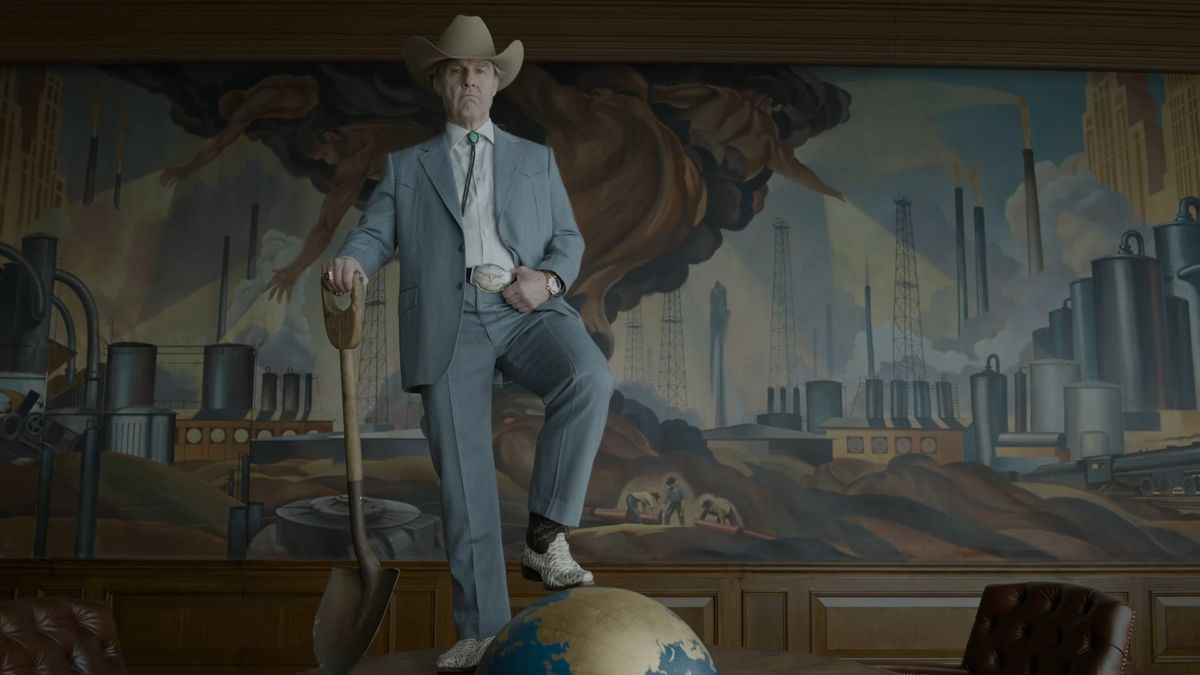
Welcome back to The Work, a column about resistance in fiction. This time: the films Digger and All of a Sudden.
A lack of easy answers is one of the hallmarks of good art, but that doesn't exempt art that attempts to answer a question from excellence. It's just risky: What if your answer kind of sucks?
This fall, two acclaimed directors returned to cinemas after some time away, each in part interested in a similar question: What can art meaningfully offer people in dehumanizing times?
Alejandro G. Iñarritu's Digger is blunt force satire on a scale that is rarely seen in cinema. An art-house director given a blockbuster budget to cast Tom Cruise, one of Hollywood's last action heroes, in a political farce made Digger immediately scan as an act of hubris, one that was swiftly treated as such at the box office. Middling reviews suggest this failure was justified, but soon the film will be available on-demand, exposed to a wider audience who might find something different there.
All of a Sudden marks the return of director Ryusuke Hamaguchi after three years away, a filmmaker beloved for his naturalistic style and richly imagined characters. The film has just completed an acclaimed run on the festival circuit, and will soon be in limited release in the U.S. where it will likely find a modest but appreciative audience.
These films are not terribly alike, and these filmmakers' proclivities are not simpatico. However, serendipity would have it that both films feature crucial moments built around theater, and in them Digger poses a question All of a Sudden has an answer for. As such, they provide us with a drama in two acts that thinks through what art can offer in a time of atrocity, when the accusation of art being nothing but a distraction feels most potent.
[Spoilers for Digger and All of a Sudden follow.]
Act I: The life and times of Digger Rockwell
At first, Digger appears to be exactly what trailers sold it as, a straightforward – if absurd – story about Digger Rockwell, an oil tycoon whose unfettered drilling triggers the climate apocalypse. Thirty minutes into the film, however, a trap door opens and a tree in the background flips onto its side as a stagehand emerges, revealing that the film is actually depicting actors rehearsing a play.
For the remainder of the film, the play continues – we see what seems to be close to the entirety of the work – with occasional breaks that give more insight into the world in which this rehearsal is taking place. We learn that the play is called Fossil Fools, that Digger Rockwell is being played by an actor named Curtis Markson, that the events and people depicted by the satirical play are more or less real, and that the theater is a haven in a flooded post-apocalyptic city patrolled by drones and robots.
As Fossil Fools gets increasingly ridiculous and blunt, frustration mounts within Curtis. The events he is depicting are within living memory, and the cartoonish skewering of the figure he's studied so closely starts to chafe. The real Digger Rockwell wasn't like the buffoon he is being asked to play, Curtis argues. As behind-the-scenes disquiet – Curtis is also concerned for the fate of his daughter, who has disappeared after boarding an imperiled flight – crescendoes alongside the chaos depicted by Fossil Fools, Digger plunges into its central question: What's it all for? What's the point of art in times of incredible crisis, when the world is being actively destroyed in front of our eyes and we ostensibly ought to be doing anything other than entertaining ourselves? Can art be resistance?
Who knows, asserts Kenny Rockwell (Jesse Plemons), nephew to the real-life Digger and secret benefactor of Fossil Fools. Kenny lurks in the background throughout all of Digger, his surname a secret until the behind-the-scenes tension reaches a crescendo, and he delivers the film's thesis: Perhaps the audience is foolish in seeking catharsis, as the artist is in seeking understanding. Perhaps all art can be is a space to sit with these contradictions for a few hours. Kenny says
"We had to get it right. It had to be bigger than life, big as Uncle Digger, big enough to convince people to brave those streets out there and witness this human-made theater play, to come to this abandoned space that we rescued and restored for people to get together again. Is it ridiculous? Is my family ridiculous? Yes. We are. Was my uncle composed? Yes. Was he frightening? Yes. Was he ignorant? Tacky, narcissistic? Yes. You all have it right. It’s funny, and it’s stupid, and it’s scary, and it makes no goddamn sense. But it happened.
I put a gazillion dollars into this production to remind people that it happened, because we were all oblivious when it did. Amused to death, absorbed in our pointless arguments, enthralled by our own opinions, just like you two right now. You’re both right. You’re all right. Now what?
Digger is a nasty little film, delighting in crudeness and invective. Its biggest setpiece is a continuous shot of a riotous hearing during which Digger Rockwell absolves himself of responsibility and lays the world's pending doom at the feet of the masses who enabled him, used his oil, and delight at trinkets delivered to their door with two-day shipping. Because of this, it's easy to read Kenny's speech as equally cynical to Digger Rockwell's – however, Digger's speech is part of Fossil Fools, and Kenny's speech is delivered to the theater company, as close to real as Digger, the film, will get.
These layers of artifice give Iñarritu an annoying level of plausible deniability when it comes to nailing down what argument his film is actually making, but it also makes it possible to read this one bit of his film earnestly. That our inability to find concrete answers to the mundane and drastic horror we see around us in art, or that said art doesn't seem an effective response to the nightmares playing out on our streets, doesn't obviate it. That perhaps just providing the space for this dissonance, this feeling of futility, is reason enough to pursue art.
It's a nice message, if a bit empty and mired in cynicism. To make art that truly makes space for people in a meaningful way, perhaps it should have the people it wants to make space for in mind.
Act 2: Up close, no one is normal
Ryusuke Hamaguchi's All of a Sudden is another film that wanders onto the stage in an effort to make room for others. The film — heavily featured on the festival circuit and playing more widely in the U.S. on November 25 — follows Marie-Lou Fontaine (Virginie Efira), the director of a nursing home in Paris. Marie-Lou is overseeing the home's transition to Humanitude, a caregiving philosophy that seeks to provide a formal structure for reinforcing residents’ autonomy and dignity. Humanitude, however, is not terribly efficient, which makes meeting the metrics that keep a for-profit care center in business difficult.
As challenges mount, an act of kindness from Marie-Lou causes her to cross paths with the visiting playwright Mari Morisaki (Tao Okamoto), who invites her to her latest production, Up Close, No One Is Normal. Upon arriving, Marie-Lou and every member of the audience is given some kind of instrument or noisemaker and no instruction for using it. The performance begins, a black-box show with only a few objects on stage with the sole actor, Gorō Kiyomiya (Kyōzō Nagatsuka). Soon, the reason for the noisemakers becomes apparent. Gorō's grandson, a young man on the autism spectrum named Tomoki (Kodai Kurosaki), is present at every performance and will invariably shout or or wander on stage, at which point he is incorporated into the performance. The noisemakers are there to encourage everyone to do what would be "disruptive" in a more "normal" show – thereby establishing a new normative baseline in which Tomoki is no disruption at all, merely another voice in the cacophonous din of humanity.
The casual, naturalistic way in which Hamaguchi reveals all this in All of a Sudden makes it profoundly moving, a small puzzle for the viewer to piece together and delight in its empathetic solution. It's sublime, seeing the entire shape and nature of a work of art thoughtfully crafted to make one person in the audience not just accepted but vital, key to the entire point.. How often do we settle for the status quo in our practice and appreciation of art? How many of our fellow humans have we left behind each time we do?
There is much more to All of a Sudden than this play and the moments that unfold during it. The film is over three hours long, and shifts its focus onto the sudden and powerful connection made between Marie-Lou and Mari, and their efforts to do compassionate work in a world that is structured to disincentivize any concerted effort to sustain and support our shared humanity. Perhaps they are naive, working as they do in the spheres of the educated and privileged, where wealthy benefactors can be courted, fickle as they may be. But in Hamaguchi's film there is a compelling answer to Digger's questions of what can be done in art, and what it can achieve in such awful times.
It's not enough to make space–one must consider the nature of that space. The form that follows function. Interrogate the conventions that make us comfortable. This isn't a very commercial practice – much like how Marie-Lou's implementation of Humanitude meets sustained resistance from both the board members above her and the healthcare workers who report to her, adopting an expansive and humane approach to any work is difficult and often thankless. You will get kicked in the teeth for your efforts, reminded that the existing status quo is there because it is the profitable one, or at the very least, the one that keeps expenses manageable.
But maybe there is an opportunity here, after the death of the monoculture, when the scramble for mass appeal has never seemed more foolish. Maybe this is an chance to celebrate work that is interested in reaching one person at a time, in making them feel not just seen but part of something, rebuilding community with different, stranger materials.
Recommended
 Isaiah Colbert