

Emily Wilson is an accomplished academic and a renowned scholar in the field of Homeric epics. Her 2017 translation of The Odyssey, which shaped the text into iambic pentameter, has sold over a million copies. She is clearly a very intelligent woman. One thing she is not, however, is a film critic.
Christopher Nolan’s The Odyssey is the biggest film in America. I enjoyed it, despite not much liking Nolan’s filmography. He is too interested in the solitary pain of hardened men to really capture my imagination, though I have always admired and been impressed by his technical ability. The man’s love for the cinema is not in doubt. I’m quite fond of his appearance in Keanu Reeves’ documentary Side By Side, which examined the history of analog and digital film. In it, Nolan speaks quite passionately about his preference for film over digital.
“I am often asked to justify why I want to shoot a film on film,” he says at the start, “but I don’t hear anyone justify why they want to shoot a film digitally.”
As much as I love video games, movies are my most cherished art form. I love a European art house flick as much as I love a tawdry comedy as much as I love an action movie as much as I love a silent film. I have a degree in cinema studies, but more importantly I watch as many movies as I possibly can.
The opening lines of Pauline Kael’s essay “Trash, Art and the Movies” put it perfectly. “Like those cynical heroes who were idealists before they discovered that the world was more rotten than they had been led to expect, we’re just about all of us displaced persons, ‘a long way from home,’” she writes. “When we feel defeated, when we imagine we could now perhaps settle for home and what it represents, that home no longer exists. But there are movie houses.”
Was she opposed to the movie being loud?
Just like Wilson feels protective of The Odyssey, I feel protective of movies—especially movies that are considered “low art,” like romantic comedies and action movies. Action movies are maybe my favorite kind of movie, often because it allows directors to get really creative with their framing, and also to blow things up. The recent Hong Kong action film The Furious has a bare bones, kind of stupid plot, but the last half hour is a stunning three way fight that’s impeccably choreographed. Those kinds of things are, I think, just as valuable as subtle human dramas—as much as I love narrative, my interest in cinema is all about what the camera can do.
That Wilson would dislike Nolan’s take on this epic poem isn’t a huge surprise. She has dedicated her life to studying and translating Homer—how could she possibly be able to see another person’s interpretation clearly, let alone like it, especially when that interpretation is on screen and not in words?
Wilson’s rather nasty pan of Nolan’s The Odyssey in The London Review of Books then is also not a surprise. Its meanness is pretty much on par for academia (“Unlike some of Nolan’s other films, The Odyssey is not boring, thanks to the source material”), and people have been calling it out for reasons I find both useful (her racial analysis is dubious, and she has since apologized) and less than useful (she should apparently be more grateful Christopher Nolan). I do think if this were written by a male academic, the tone would not even be discussed. Wilson is an accomplished person in her own right, and she owes nothing to Nolan.
What has made me feel defensive over The Odyssey—a film I really liked but didn’t quite love—is that her disdain appears to extend to Nolan’s chosen form of the action movie. Nolan has made a lot of action movies. I think they encompass the majority of his career. While I think the movies he makes are largely pretty dumb, he has a real talent for spectacle which is enhanced by his technical ability. What I’m saying is: whenever I see that real, actual 747 crash into a building and explode in Tenet I hoot and holler like a child giddy on lemonade. Seeing that kind of stuff, artfully composed, is one of the reasons why I love movies.
It is apparently not among the reasons why Wilson likes movies. Many of her criticisms of Nolan’s Odyssey center on the things that make an action movie an action movie.
“Without a tub of wax for my ears,” Wilson writes, “I was exposed to the full din of thumping sticks, staffs, swords and clashing armour, thunderbolts, crashing waves, grunts, screams, toppling palaces and burning temples.”
The paragraph goes on to explain that these sights and sounds did not inspire in Wilson “any agony of emotion,” which is fair enough. But one would expect an action movie based on The Odyssey to contain grunts, screams, crashing waves and thunderbolts, right? Was she opposed to the movie being loud?
Wilson appears opposed to spectacle in this film entirely. In the first paragraph she writes that the film is “a family-friendly audiovisual spectacle.” A few paragraphs later she writes, “Nolan’s spectacle threatens to drown out his story.” She compares the movie unfavorably to 2024’s The Return, which depicts only Odysseus’ return to Ithaca, writing that it has a “stylish sparseness” that Nolan’s film lacks. But choosing to be spare where another director would not is not a marker of quality.
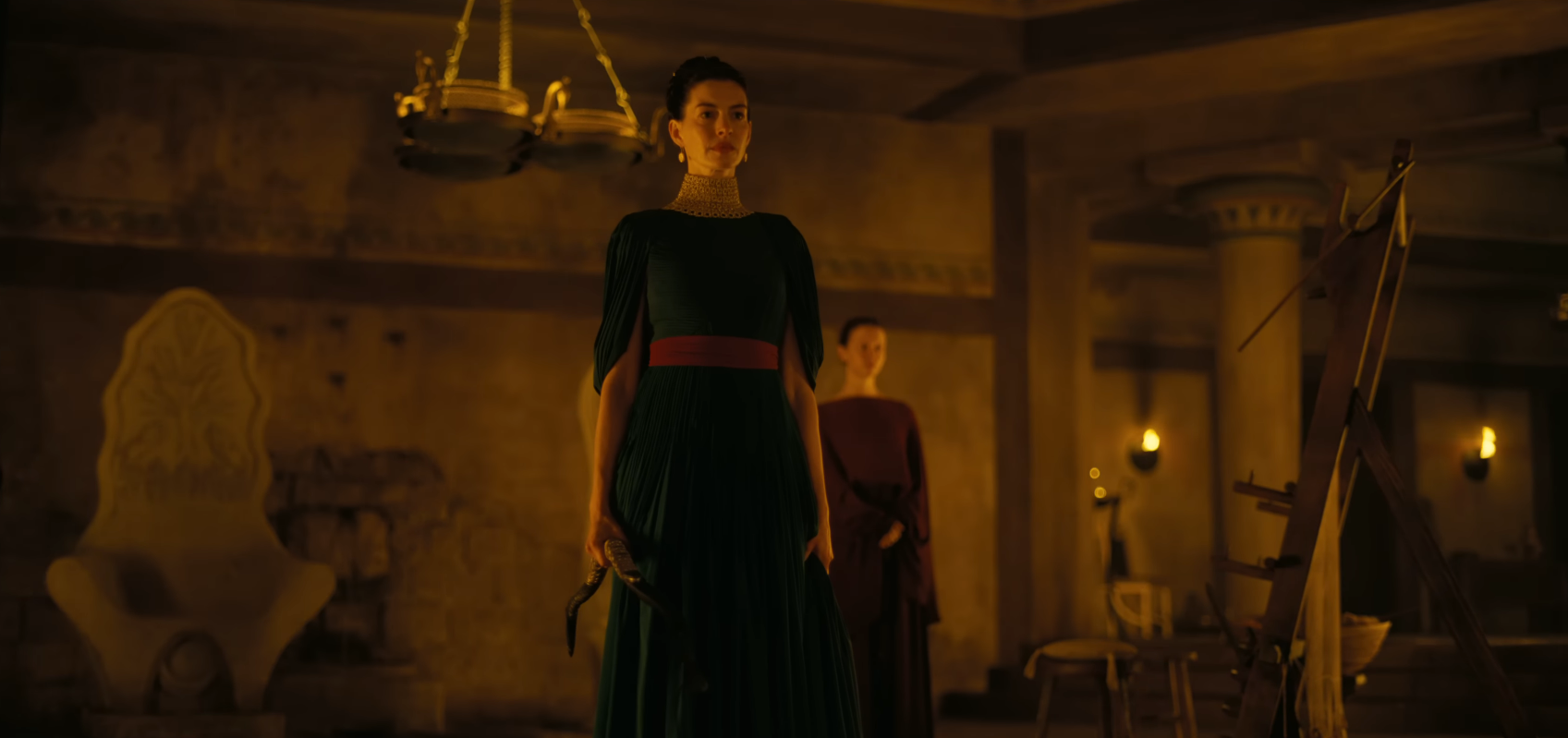
The Return is an intimate human drama from a director who basically specializes in that. Nolan isn’t that guy. He’s never been that guy. Even when he does a biopic about Robert Oppenheimer, the film centers around a massive explosion. You can like or dislike these qualities, but they do not make a movie good or bad. They are simply choices.
Later on, she compares The Odyssey to Lord of the Rings. “In looks, this Odyssey is often reminiscent of other 21st-century screen ‘epics’, not least Peter Jackson’s Lord of the Rings trilogy,” she writes. “The visit to the Land of the Dead reminded me of the excursions beyond the Wall in Game of Thrones.”
I truly do not know what she is talking about here. The Lord of the Rings is a series of films that become remarkable because of how huge and expansive they feel. That famous shot from the Fellowship of the Ring, where the titular fellowship crests a mountain, the score swelling as the camera pans around them, is designed to make us understand the hugeness of the world, how small they are as actors within it.
Comparatively, The Odyssey is an extremely claustrophobic film. Nolan is not interested in sweeping pans of mountains and the wonder of nature; he is more interested in the discomfort that happens when you spend a long time with a bunch of dudes on a boat. Even though Odysseus and his crew are on an epic journey, their world feels small. As the boats are rocked by the sea, the audience is placed on the boat, alongside the crew, the night so dark that the viewer can’t see beyond the boundaries of the boat itself. This imagery is reinforced elsewhere, like the scene depicting Odysseus and his soldiers within the Trojan horse, stacked on top of each other and slowly drowning as the tide comes in.
The comparison to Game of Thrones similarly baffles, because the treks beyond the Wall in the television show are notably in a frozen wasteland, whereas The Odyssey’s journey to Hades takes place on a beach. They’re not even tonally similar. If you end up beyond the Wall on Game of Thrones, you’re in a lonely, desolate arctic climate, notable for its monsters and lack of people. It’s brutally physical and suffused with danger. In The Odyssey, the Land of the Dead is more a spiritual location, a dream-like non-place where the dead may speak to Odysseus. If there’s any pop cultural comparison to draw, it's probably Ryan Coogler’s Black Panther, with its spirit realm that allows Wakandans to speak to their ancestors—another dreamspace that mimics physical spaces but leans into their uncanniness.
A script is not a sacrosanct document.
Much of Wilson’s criticism of the film focuses on the script and the writing, calling elements she dislikes “underwritten” or “underdeveloped.” I can see why a translator of an epic poem would place so much emphasis on the words being spoken on screen; that is her area of expertise. She writes that “I would be ashamed to have written any part of this script,” which is a really weird thing to say when you didn’t work on a script and were not invited to do so.
Complaining about the script is a kind of cinema critique from laypeople that I have honestly grown to despise. A script is not a sacrosanct document that is used like a bible to guide every aspect of production. A lot of the time, a script is a suggestion. Some movies are shot without a script, which can be a disaster in some projects (the Marvel Cinematic Universe) and revelatory in the hands of a true artist, as in the case of George Miller’s Mad Max: Fury Road.
Even in cases where a script is more important to the production of a film, that’s a document that passes through a lot of hands while a movie is being shot and edited. There will be new lines and scenes added by the actors and director (though probably not the writer, because there’s no reason to have the writer on a shoot most of the time). Conversations, scenes, or even entire performances will be tweaked and shaped during the editing process. The difference between a script that’s being used during a film shoot and the end product that ends up in theaters is kind of like expecting a fully grown adult to be the same person they were when they were three. A lot of shit has happened in the meantime!
And Nolan has not really been interested in dialogue in his films, pretty much ever. Nolan is a huge believer in the power of the montage, that by placing sounds and images together you can create new meaning. Tenet is basically an exercise in montage taking precedence over story and plot. It trusts that the audience will feel at the very least wonder, if not anxiety or grief, over the images they see. Famously, Nolan’s movies often have dialogue mixed very low, sometimes making it unintelligible or inaudible. I don’t think this is an error on his part—he just doesn’t find spoken language all that important.
That isn’t to say that no writing goes into making films. The writing is everywhere. Scripts are also descriptions of what shots will look like, clues into the characterization of the parts that actors will play and make their own, markers of mood and tone. A scene in a movie in which no characters speak is a “written” scene, even if, at the end of the day, movies are made of images rather than words.
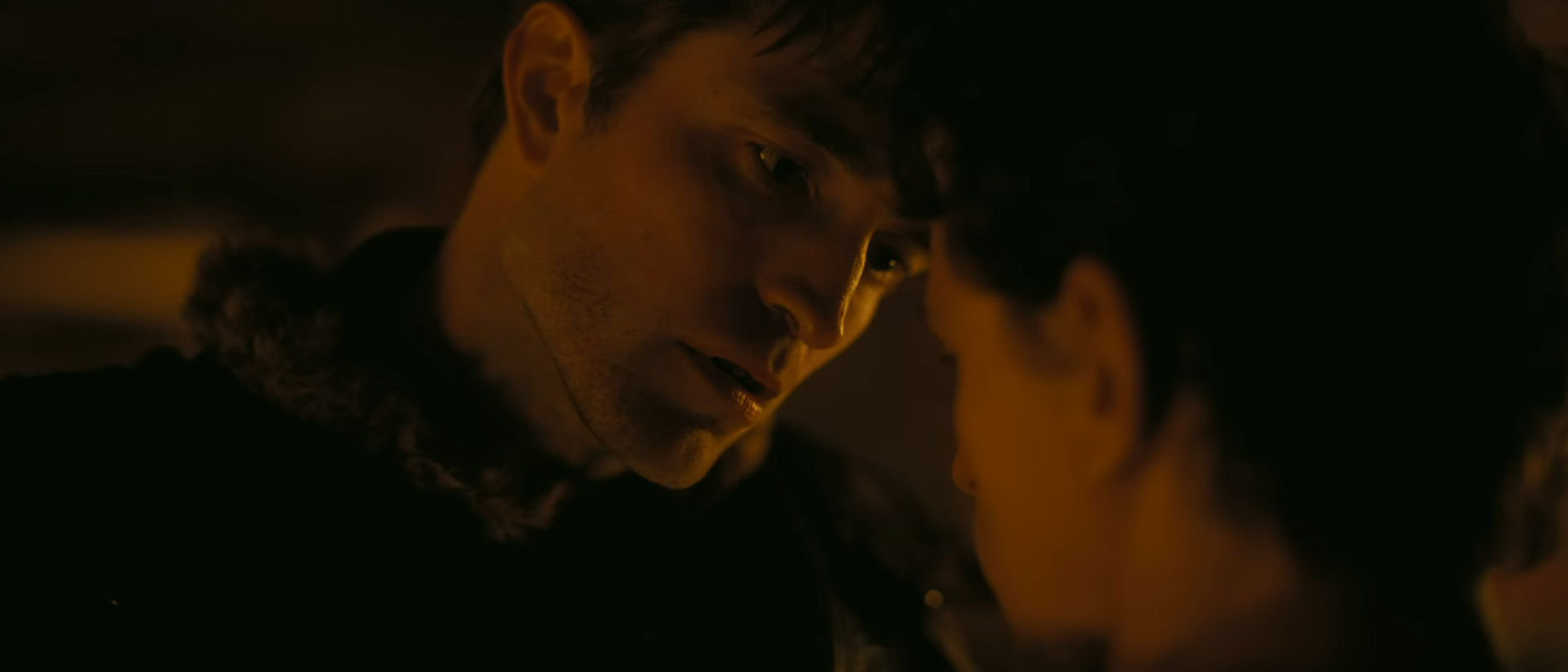
Even if The Odyssey is based on an epic poem, when it’s translated into a movie it can become many things, depending on genre. In reading Wilson’s essay, I feel like her main criticism of Nolan’s The Odyssey is that it is an action movie at all—that it has spectacle, that it's loud, that Agamemnon’s armor is a visual reference to Darth Vader. But it is the bigness and the loudness and the striking images that action movies create their meaning. One of the most loaded and exciting images of all time is Will Smith emerging from a KKK robe during an undercover sting in the opening of Bad Boys II, orange light dancing off his dark skin as his body mirrors the burning cross behind him. The movie is really dumb, but that doesn’t have an absence of meaning.
Honestly, I think most of Nolan’s movies are really dumb, especially the ones that strive to have a deeper meaning. Interstellar I found interminably dull, some of the worst of Nolan’s depictions of women, nor did the spinning top of Inception capture my imagination. The images are the stuff I chew on after his film. I think that’s why Nolan’s movies make such great memes—they are urgent and not overcomplicated. Robert Oppenheimer clutching his face in horror can now stand in for every time every one of us has had a terrible revelation, in the same way that Will Smith pointing downwards at Martin Lawrence from a scene in Bad Boys II will now and forever be translated as “that’s some funny shit.”
A deeper, more intellectual take on the story appears to be what Wilson wanted. She calls the overall thesis of the movie—that society is breaking down due to a social contract being broken—as “relentlessly didactic.” I do pretty much agree. Nolan’s movies are about as subtle as a brick. A lot of people don’t like this—don’t like his bad dialogue and flat characters—but I try to appreciate the qualities about his work that excites me. It’s okay to enjoy a stupid movie. And stupid movies aren’t always bad ones.
The moving image is a language of its own.
“Perhaps more surprising from the director of Oppenheimer,” Wilson writes, “[Matt] Damon’s lummoxy Odysseus also seems to lack technological intelligence (polymēchania). He does not build a marriage bed out of a tree growing in his house (it would be a waste of effort, since he so rarely seems to sleep or have sex).”
Why should Nolan’s depiction of Oppenheimer mean that his depiction of Odysseus must possess technological skill? Should he also be able to invert his boats and weapons as the characters do in Tenet? This is the trap of believing that Nolan strives to do anything other than make movies that make you say “hell yeah brother.” He does have an interest in lofty ideas, but mostly as a basis for creating spectacle.
It’s true that Damon’s Odysseus is “lummoxy,” feeling a little bit like Jason Bourne in armor, but that way he embodies the Odysseus that Nolan has sculpted for this film is honestly really enjoyable. My mom texted me and told me that she loved the way he ate the lotus flower, like a little mouse. For me, I love the way he tells Eurylochus that he wants to be tied to the mast so that he can be the only one to hear the siren’s song. He sounds like he’s about to do a stunt on Jackass. The casual arrogance of his speech, his harsh American accent, the Bourne-ness of it all seem to be the point of this portrayal. He’s an action hero, and we’re seeing what happens after the big battle when everyone goes home.
Near the start of this essay Wilson writes that “Adaptations needn’t and shouldn’t follow the original with anything like the exactitude of a translation,” but the rest of the essay doesn’t really support that notion. If that were true, she would not take such an issue with the things that denote that The Odyssey is an action movie. She seems not to get that the moving image is a language of its own, with its own grammar and syntax, and learning how to read cinema is its own skill—one that she lacks.


