

“Is this AI?” my girlfriend will ask me, pointing to a post on TikTok or Instagram. If you’re online, you ask this question every single day. As the years have gone on and the models have gotten deceptively better, the talent of discerning what is and is not AI has entered into an arms race with what the models are capable of. This learned suspicion is fatiguing, and being baited and switched is like going out to see a movie only to be confronted with a video of someone describing a boring dream instead. There is no baseline for the veracity of images; they start at suspicion now.
This has all become the most convoluted and exhausting when it comes to my hobbies. I am a man who cares deeply about open source software, particularly projects that destroy the barriers between existing platforms. I care about accuracy in retro gaming quite a bit; I wouldn’t have spent years restoring an arcade cabinet by hand if I didn’t. But I also care about passion and rigor, about a person making software because no viable alternative exists or because nobody did it correctly, and devoting a big portion of their life to maintaining that for strangers. (Perhaps I should not fetishize labor like that, as much of open source software can turn developers into janitors.) But what is happening now with AI has made it difficult to discern who cares and who doesn’t, who knows what they are doing and who cannot be bothered to check what code they shipped. I’m exhausted.
Over the last few months, we’ve seen an explosion of “decomps,” projects intended to take existing games, decompile the source code, and free them of their software ecosystem. Decomps as a concept have a long history before this current wave, and outside of making the games compatible with new hardware, the utility for communities that want to mod their games is clear. Historically this process has been deeply tedious work, with projects like Sonic Unleashed port UnleashedRecomp, the Ocarina of Time port Ship of Harkinian (which itself had an AI coding controversy) and Dusklight, the Twilight Princess port. Wes Fenlon, who runs the excellent Read Only Memo, keeps an ongoing list of active decompilation projects in progress and has to contend with this ongoing flood.
But with the release of models capable of replicating something resembling a finished project, the number of fly-by-night ports has increased dramatically. This is not magic, as these models are partially trained on the uncredited work of people who do actually put the tedious time in. And just because an AI assisted “decomp” runs, does not mean the finished product is accurate to the original code. This situation prompted one of the devs of Dusklight to sunset decomp.dev, a website dedicated to tracking decompilation projects.
“It is now clear that, with the right guidance, human input, and code reviews,” Luke Street, who goes by Encounter, wrote, “AI can expedite the decompilation process in a significant way. What is also now clear is that the community aspect of decompilation has been broken. Our projects have always been open source to encourage contributions and to benefit the community as a whole. Bad actors have been abusing this in increasingly troublesome ways.” Smith goes on to describe the various ways that this baseline level of trust has been demolished, such as forking and “finishing” the work of people who have put the time in, as well as muddying the definition of a decomp to mean any port and thus devaluing extremely tedious and difficult work.
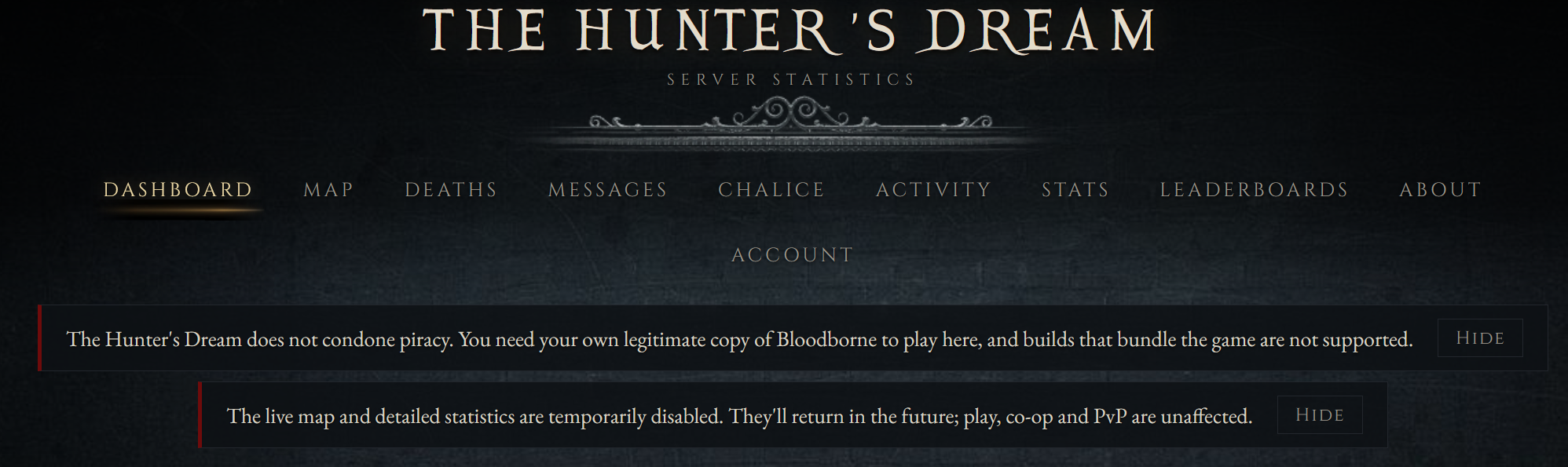
The results of this wave of decomps are often uneven, unserious, or not even debatably true decomps at all. People praised a recent Bloodborne port, but it is partially based on ShadPS4, an existing PS4 emulator, for the renderer. Since that version, there’s been an explosion in forks of the port. The sheer number of splinter projects makes the simple question of “how do I play this on PC?” more convoluted, and some of those ports have had unintended consequences. Recently a prominent piracy site started packaging a fork of a port by GitHub user Jgamrot. This caused The Hunter’s Dream, a community-run multiplayer server, to be flooded by people playing the game and slamming the server with repeated requests. The Hunter’s Dream was forced to ban the entire fork, for both the impact on its servers and its impact on people annoying them on Discord, and because they have a stated no-piracy policy and want people to just dump their own games manually. (I reached out to one of the mods of THD, but they politely declined to comment on this story.)
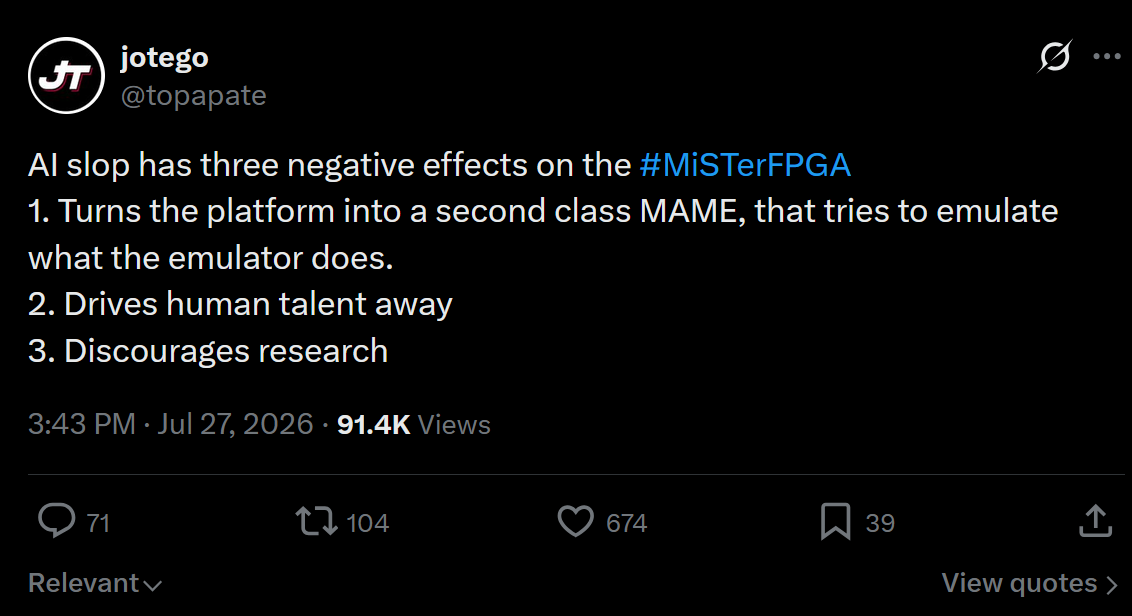
These same problems with fly-by-night slop development have also impacted the development of MiSTer cores. The MiSTer is an open-source development board that uses FPGA technology to emulate old games on a hardware level, and I’ve talked about it extensively on this site. The aim is, supposedly, accuracy. But there’s been a slow creep of slopped-up cores over the last few months. Last week I saw someone had released a core for Canon Dancer AKA Osman, one of my all time favorite arcade games. It is an almost psychedelic work, made by the director of Strider whose visuals I can only describe as cyberpunk by way of the Middle East. I’d hoped that someone would take the time to properly develop a core so that I could christen it when I finished my arcade cabinet, but unfortunately the core seems to be by a slop artists. Thankfully, a fantastic remaster of Canon Dancer was released a few years back. I highly recommend that you buy that if you want to play it.
Even when AI coding is technically employed on a seemingly well-made project, how one reports on these projects becomes murky and often throws you curveballs. Recently a port of P.T., perhaps the PS4’s biggest white whale outside of Bloodborne, not only shipped but was shared by its creator Hideo Kojima. The port itself appears to be technically competent, with hacker Lance McDonald co-signing it on X “writing, Unlike the previous decade of fan ‘recreations’ of P.T. for PC which always seemed to miss important but minor details, this is (as far as I can tell?) a 1:1 port of the entire codebase. It creates all of the undocumented behavior I know of perfectly.” Digital Foundry did a video on it, and I can confirm that it runs, adding both Raytracing and VR as options (although I did not extensively test the VR features for longer than 10 minutes because I did not want to have a heart attack.) The person who worked on it, Lorean Xavier, had been working on ShadPS4 projects for at least a year and seems like he had some familiarity with the code. Lorean also later disclosed that he had used AI for debugging and certain tasks. Following this disclosure, as well as the resurfacing of some old problematic posts praising Kanye West, Lorean apologized for past statements and announced he would no longer be working on the project.
I bring this up not to comment on the integrity of the project or its developer, but because the choice on how to cover a project like this frequently grinds to a halt in the presence of so many potential variables and red flags. The question of whether or not debugging is a valid use case for LLMs notwithstanding, verifying the extent to which AI was used on a project is getting increasingly difficult and uncanny as the tells become harder to spot. My default is now suspicion, and the field of potential projects to highlight widens immensely as countless repos spring up built on the unacknowledged work of others. This doesn’t just impact retro projects, but new games as well, as we reported some game creators fear putting demos out on Steam Next Fest for fear of being scooped up and cloned by poorly made imitators.
 Nathan Grayson

These technologies also put a significant strain on existing communities that do not want them. A fantastic example is the influx of GenAI proponents on ROM hacking. Shoujo, a developer and hack section lead for SMW Central (the primary hub for Super Mario World hacks) has a fantastic postmortem on the topic titled "Who Owns ROM Hacking?" And Other Questions AI Poisons Us With.”
"It angers me to see people use GenAi in communities focused on human creativity.It angers me to see such poor justifications for GenAi use. It angers me to see the entitlement that GenAi users feel when it comes to the art of other people. It angers me to see the victim mentality that GenAi supporters have adopted. It is difficult for me to comprehend why people would still choose to engage with GenAi despite the environmental impacts, the destruction of culture and communities, the harm it causes to those living around data centers, and the massive amount of plagiarism required for its function.”
The viral cycle of these projects, something almost bigger than their actual claimed utility, has clearly influenced people with power and money who regularly post on X. Xbox CEO Asha Sharma explicitly mentioned recomp projects in a recent announcement of the XBOX LABS initiative, and Epic is clearly comfortable enough with vibecoding to use it to make a new launcher that runs like garbage. If this is what we can expect from companies worth billions, the future is dire.
 Chris Person

Discussions of the utility of LLMs, though valid to have, can also become an endlessly tiresome and circular trap. Nobody leaves convinced, and the stated usefulness or ubiquity of a technology does not absolve it of its consequences. Tetraethyl lead was a solid knock inhibitor, but that does not make the impact and global spread of leaded gasoline less real (to borrow a metaphor originally made by Glyph). Similarly, the potential utility of LLMs does not make their impact on the environment, labor, technical debt, their reliance on outright plagiarism, the basic cost of computing, and the deskilling of engineers any less real. I have heard from many friends who have been forced, either implicitly or explicitly, to use LLMs for work. You should not be reading Hacker News headlines titled “Ask HN: How to deal with shipping AI-written code you don't understand?” The phrase digital asbestos was used in a fantastic rundown of the many retro projects that have turned out to be vibe coded, including broken fan translations. I quite like that as a metaphor, and like many technologies that prove to have negative environmental consequences, once it’s in there it’s difficult to get it out. AI code is in everything, it’s in the Linux Kernel, and sometimes that ubiquity makes the job of assessing a piece of software more akin to being a building inspector.
 Chris Person
Outside of games
The first time I remember a vibecoded project going comically south was about eight months ago with Huntarr. Huntarr was a piece of software meant to unify the *Arr ecosystem of programs, namely Sonarr, Radarr, Lidarr, Readarr (now discontinued), and Whisparr. These programs are typically used to monitor bitorrent and usenet RSS feeds and automatically download content in each of their categories, often illegally. Huntarr, it turns out, was not just vibecoded but comically insecure. In a post on the r/selfhosted subreddit titled “Huntarr - Your passwords and your entire arr stack's API keys are exposed to anyone on your network, or worse, the internet.”, user exe_CUTOR laid out the various security flaws in the software. “Anyone who can reach your Huntarr instance can rewrite your entire configuration and the response comes back with every setting for every integrated application in cleartext,” exe_CUTOR wrote. Eventually, the Huntarr github repo was taken down and the subreddit was locked.
The lack of rigor in vibecoded projects and associated security risks is a huge ongoing concern. Recently 404 Media ran a piece about people hacking otherwise closed or bricked devices using AI. It’s a solid rundown of some recent examples as well as potential perils, and the topic of hacking otherwise proprietary hardware is near and dear to my heart. I regularly check and have reported on the XDA forums in the past when it comes to turning closed devices like the Echo Show inside out. The 404 piece mentions smart picture frames, bricked Lululemon smart mirrors, and smart TVs specifically. Jason Koebler was quite apt to point out that this is something that you can already do in the case of the Smart Mirror.
 Chris Person

But in the case of the viral TV debloat post on X by user gathint, the magic wasn’t in the AI and it wasn’t magic, it was Claude running a bunch of ADB commands over wifi. A lot of TVs are just big Android devices and the ADB command (Android Debug Bridge) is what you use to send commands over USB or WiFi. When I hacked multiple Amazon Echo Shows I used the ADB sideload command to do it. The original tweet also claimed to clean up the interface with a new launcher, but that’s not new either, and cleaner launchers that more closely mimic the Apple TV already exist for that ecosystem.
Another viral repo that the piece pointed out was Reverse Engineer Anything, a piece of software that tasks AI agents to reverse engineer features in software. However, if you look at what powers REA it’s software like Hopper, Ghidra and IDA among other things. Ghidra is an incredibly powerful tool created by the NSA and released in 2019. Hopper and IDA are not particularly new either. Though it did not make it into my final piece, it’s also the tool that user Rortiz2 used to reverse engineer the hack for the Amazon Echo Show.

I bring this all up only to deflate, if only a little, the X virality of some of the more recent claims. It’s valid to take software like this seriously, particularly when it brings together multiple pieces of software into something that’s convenient to use, but the important part is what the software is built on. Though still dangerous, saying that a piece of software can reverse engineer anything is slightly less impressive when you add “you simply need a chatbot and a powerful piece of reverse engineering software made by the government.” That’s also not a particularly new concept itself. Many of these claims are more banal than what their proponents loudly post, like the headline-grabbing attempt to functionally recreate (but not decompile) Adobe’s software suite. I hate Adobe more than most people, but the resulting software suite was unserious, didn’t really work, and only superficially looked like what Adobe had spent years constructing. Any attempt to reconcile what these technologies are capable of must start with being honest of what they are incapable of, such as magic.
Alienating long time contributors, slopping up jailbreaks
These fly-by-night projects can also have serious consequences on people who have been pillars of existing hacking scenes. I’ve thought a lot about the recent controversy involving Andy Nguyen, also known as TheFlow, a long time PlayStation modder and hacker. TheFlow is a legend in the hardware hacking scene, and Vita hacking only exists in the state that it’s in part because of him. Earlier this year, he announced a jailbreak for the PS5 that allowed it to run Linux. When I was reviewing the Steam Machine and making my BC250 build for Aftermath, I also reached out to TheFlow in the hopes of writing a second companion piece about Linux on PS5 for the Steam Machine’s launch. The BC250 is functionally quite similar to a PS5, and with hardware getting expensive due to data centers, liberating otherwise closed hardware is becoming wildly important.
I ported Linux to the PS5 and turned it into a Steam Machine. Running GTA 5 Enhanced with Ray Tracing. 🤯 pic.twitter.com/aMbT0PQ1dS
— Andy Nguyen (@theflow0) March 6, 2026
The original announcement of Linux on PS5.
That piece never materialized. Though we did briefly talk, he didn’t get a chance to respond to questions in time and I didn’t have the budget or time to track down a PS5 with the correct firmware. But last month he announced that he was stopping all work on PS5 Linux. “I am stepping away from the ps5 scene and stopping all my work on ps5 linux. After pouring my heart and months of my life into it, including plans to finish ps5 pro support and release in 2027, it's all down the sink,” Nguyen wrote. “The scene used to be a group of highly talented researchers, but now it is just a bunch of noobs using LLMs and writing hacks they don't even understand. Slop kiddies found the only hypervisor bug left, which I had also found a while ago, and decided to report to Sony. I asked them to at least wait for GTA 6 to come out so that people would have the opportunity to legally purchase the game and also enjoy linux. They agreed to wait, but not a day passed and they decided to waste it instead.”
Kotaku has a fairly decent rundown of the full story, the details of which are messy. A second hacker found the same hypervisor exploit with AI and reported it for money after a third found it. You can debate the ethics of the situation all you like, but alienating a long time contributor to the scene is genuinely heartbreaking to me.
Jailbreaking the PS5 has still continued without him, but like many communities it’s become increasingly vibey and slightly annoying to follow the progress ever since. I hope he comes back some day.
Between submitting this piece as a draft and its publication, video of a claimed Switch 2 jailbreak surfaced. The hack as described appears a bit convoluted; finding it involved throwing Codex at the problem, and running it relies on running the hack every single time at bootup. The part that I do think is amusing is the video showing an automated lightswitch clicker robot the hacker got on Amazon to press the Switch 2 power button in a Pee-Wee Herman Breakfast Machine manner. If valid, it seems significant. The hacker showed it off by showing a video claiming he slop modded Cinnamoroll and an Angry Bird into Mario Kart, which I find tedious and corny. Unfortunately when it comes to finding jailbreaks and pentesting, AI appears to be here for good, it just feels increasingly artless.
 Chris Person

On top of all these many specific examples there are all the countless times I’ve looked for a solution only to find an entirely vibe coded answer, countless tiny github repos with ugly, samey interfaces that never get maintained. This stuff has seeped into the soil like a crude oil spill. There is so much viral hyperbole about what these things are capable of that is often followed by a sobering and less sexy reality. What I mourn is the loss of trust, the alienation of people with institutional knowledge and the chaotic disruption of real communities by strangers walking in like a toddler with a Glock.
What I always valued about these projects most was the care, and my heart is filled with joy when I see people that still do. But it’s getting harder to parse that part out, and I grow tired of weighing the hearts of strangers against a feather. There is so much noise now that the signal can often be barely perceived, and projects I’d normally be excited about are getting crowded out by the loud and the careless. I don’t really have a solution to any of this (it would be pretty funny if I did); I just know that constantly having to dig through the muck is dragging me down.


